
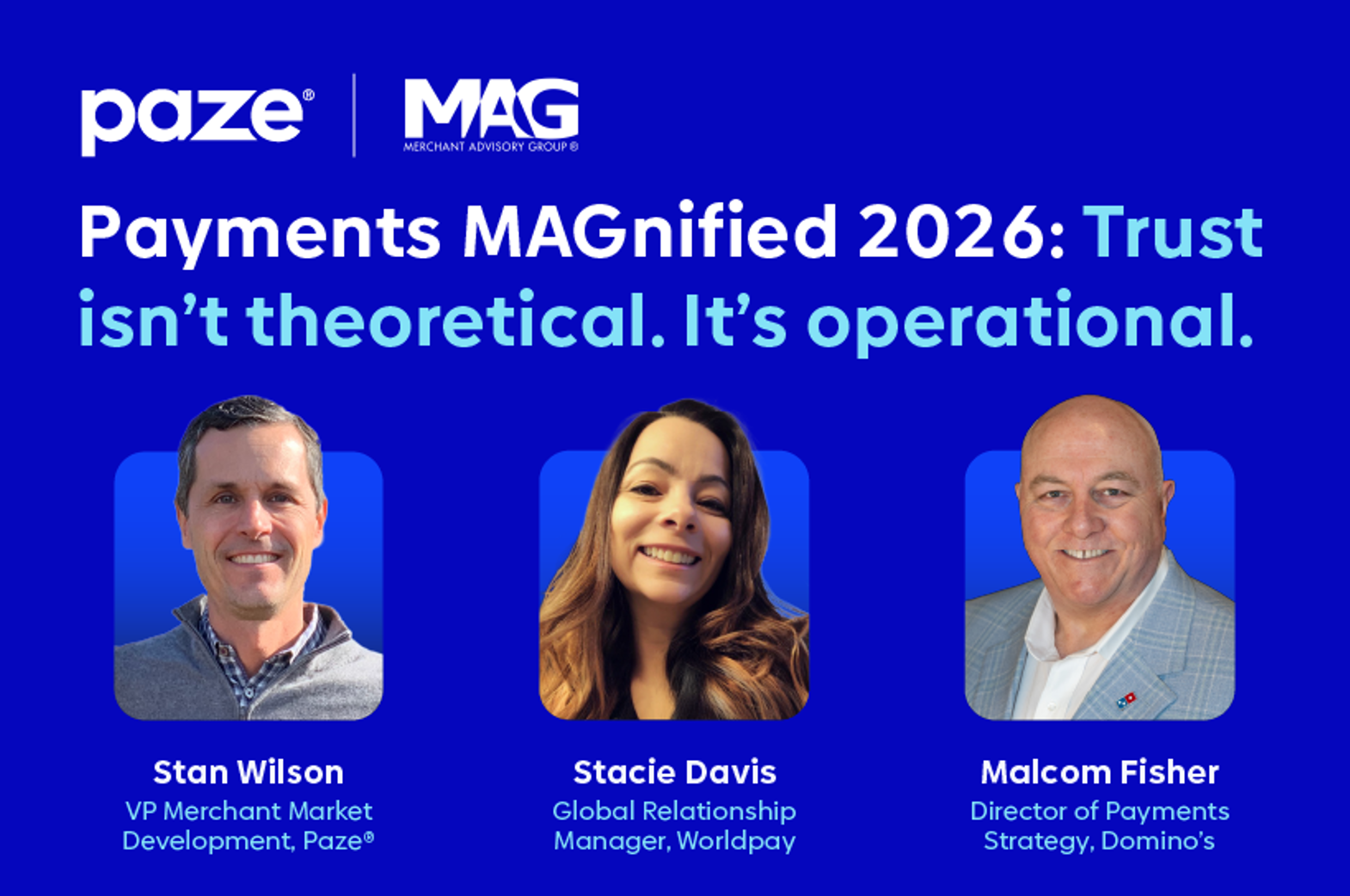
At Payments MAGnified 2026, Domino’s Director of Payments Malcolm Fisher, Worldpay Global Relationship Manager Stacie Davis, and Paze VP of Merchant Market Development Stan Wilson spent 30 minutes working through what trust actually means in the payments ecosystem—operationally, not theoretically. Here are the key exchanges from that conversation.
Do speed and trust compete?
Moderator (Rene Pelegero): In a world where Domino’s is built on speed, do speed and trust conflict? Which one wins?
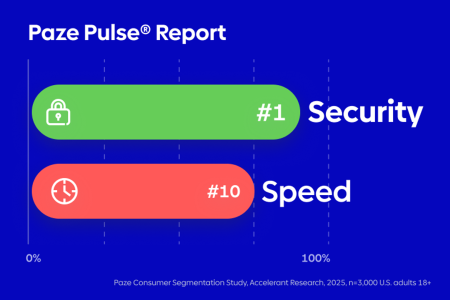
Malcolm Fisher (Domino’s): They don’t compete. Speed, trust, and friction are complementary. It doesn’t matter how many millions of dollars we invest in apps, automation, or ordering platforms — when customers reach the payments page, it’s the moment of truth.
On Super Bowl Sunday, we processed 132 transactions per second. Speed is mandatory. But we never remove trust to achieve it.
Stan Wilson (Paze): Without trust, there is no payments ecosystem. E-commerce cart abandonment is upwards of 70% today. That suggests there’s room for improvement across the entire chain — and much of it comes back to trust.
Where does trust break in the payment chain?
Moderator: Where do you see trust break down across the payment flow?
Stacie Davis (Worldpay): It can break at any point in the payment lifecycle, but it’s especially critical at both ends. By the time a consumer reaches checkout, they’ve committed to the merchant, the cart, and their payment method. Securing that authorization is a critical vulnerability point.
We all want the same outcome — merchant, issuer, cardholder — all players want an approved transaction. Monitoring authorization rates as a key KPI is essential because a lost authorization is a lost sale.
Growing the wallet market, not splitting it
Moderator: How do you build trust in a market where consumers already have preferred wallets?
Stan Wilson (Paze): We see it differently. This isn’t a zero-sum game — we’re here to help grow the pie. Look at our sister business, Zelle®. From a standing start eight years ago, it powered more than $1.2 trillion in peer-to-peer payments last year — over 400 million transactions across 150 million users. That growth came from combining bank trust with innovation..Our goal is to work across the ecosystem to improve digital checkout — better fraud rates, higher authorization rates, and more seamless experiences. That benefits everyone.
Wallets, fraud, and the end of plastic
Moderator: If you could change one thing about today’s ecosystem to better balance speed, convenience, and security, what would it be?
Malcolm Fisher (Domino’s): I’d reduce plastic and expand wallets. Wallets inherently add trust. The next generations don’t want to carry physical cards. In ten years, I wouldn’t be surprised if plastic largely disappears.
More wallet transactions can reduce fraud costs because wallet fraud rates are negligible compared to manual entry.
Stan Wilson (Paze): Manual card entry is a primary driver of high transaction drop-off rates, especially on mobile devices. It also carries a high risk of card-not-present fraud. Bringing in a bank-offered digital wallet like Paze signals a high commitment to trust. It’s about delivering both speed and security — enabling retailers like Domino’s to sell quickly while maintaining trust without forcing a trade-off.
Accountability when things go wrong
Moderator: What does accountability look like when so many players are involved?
Stacy Davis (Worldpay): Accountability, ownership, and most importantly, open lines of communication really matter. Those are the keys to trust. When something goes wrong, at the end of the day, it doesn’t matter whose fault it is. It’s not about pointing fingers. Having a good partnership means you keep the line of communication open. Trust creates freedom. When I trust my partners to handle issues, I can focus on growing the business.
Malcolm Fisher (Domino’s): The partners who earn my trust are the ones willing to get on a call — whether it’s technically their problem or not — roll up their sleeves, and work through it as part of my team.
False declines: a trust problem?
Moderator: Are false declines a trust problem? And if so, who’s lacking trust?
Malcolm Fisher (Domino’s): I’d blame the issuer, but that’s just me.
Stacie Davis (Worldpay): No one loves a “Do Not Honor” decline code. But this is a balancing act. The systems validating authorization exist for a reason: to protect against fraud. The challenge is making them smart enough not to filter out good customers.
Stan Wilson (Paze): This reinforces the opportunity for digital wallets. Reducing manual entry — where fraud and abandonment are highest — can improve both approval rates and customer experience.
Mandated authentication: one size fits all?
Moderator: Would mandated strong customer authentication, like Europe’s 3D Secure, accelerate wallet adoption?
Malcolm Fisher (Domino’s): It won’t work for pizza. That’s friction. And in many cases, we’re already authenticating — customers use Face ID or device biometrics.
Stacy Davis (Worldpay): It depends on the purchase. Europe’s 3D Secure mandate was heavily influenced by high-ticket categories like travel. A blanket solution may not move everyone in the right direction.
Payments are generational. My teenagers don’t use cash. If they receive it, they ask me to deposit it. They won’t shop anywhere that doesn’t accept digital wallets.
Stan Wilson (Paze): It doesn’t have to be a sledgehammer. Different transactions carry different risk profiles. A $20 pizza and a $1,500 cart require different approaches. Technology now allows us to apply the right solution at the right moment — not a one-size-fits-all mandate.
AI, agentic commerce, and what comes next
Moderator: How is AI changing how you think about trust and customer experience?
Stan Wilson (Paze): With the rise of agentic commerce, trust becomes even more critical. If AI agents are transacting on a consumer’s behalf, the ecosystem must be trusted.
As a bank-offered digital wallet, Paze securely provisions cards from issuers. If we’re enabling AI agents — just like enabling employees or partners — trust in the participants is paramount.
Is AI trustworthy?
Moderator: Do you find AI trustworthy today?
Stan Wilson (Paze): I think many of the tools today still bring questions of trust and there’s a lot of uncertainty for all of us as we’re learning. Where are the lines? Where does your data go? For enterprises implementing AI, are those enterprise walls really there? Is your data escaping into the broader cloud, into the broader ecosystem? Those are things that we’re going to have to learn together.
Malcolm Fisher (Domino’s): There must be governance. There must be standards.
Stacie Davis (WorldPay): I joke with my teenagers that AI has ruined the Internet for me because every cool thing I see may not be real. I take that sort of cynical mindset into my job as well. I don’t want to present my clients with solutions that I don’t feel trust in myself, that haven’t been fully vetted, that haven’t balanced speed versus risk versus friction. While you need to adapt early and be very cognizant of the fact that AI has arrived, you also must have players involved that you can trust.
The throughline: trust enables growth
Across every topic — speed, wallets, fraud, authentication, AI — one theme remained constant: Trust isn’t the opposite of speed. It’s what enables scale.
Interested in implementing Paze or establishing a partnership? Contact the Paze team.
This transcript has been edited for clarity and length. Remarks reflect a live conversation between Malcolm Fisher (Domino’s), Stacie Davis (Worldpay), and Stan Wilson (Paze), moderated by Rene Pelegero from the Retail Payments Global Consulting Group, at the Merchant Advisory Group Annual Conference, February 2026.





 at checkout?